I built a satellite tracker nobody asked for. Then PCWorld called.
Well, nobody called exactly. But azmth, a hobby that got out of hand, somehow ended up in Morning Brew, on PCWorld, and briefly on the command-center wall of a national telecom regulator. Here is how that happened.
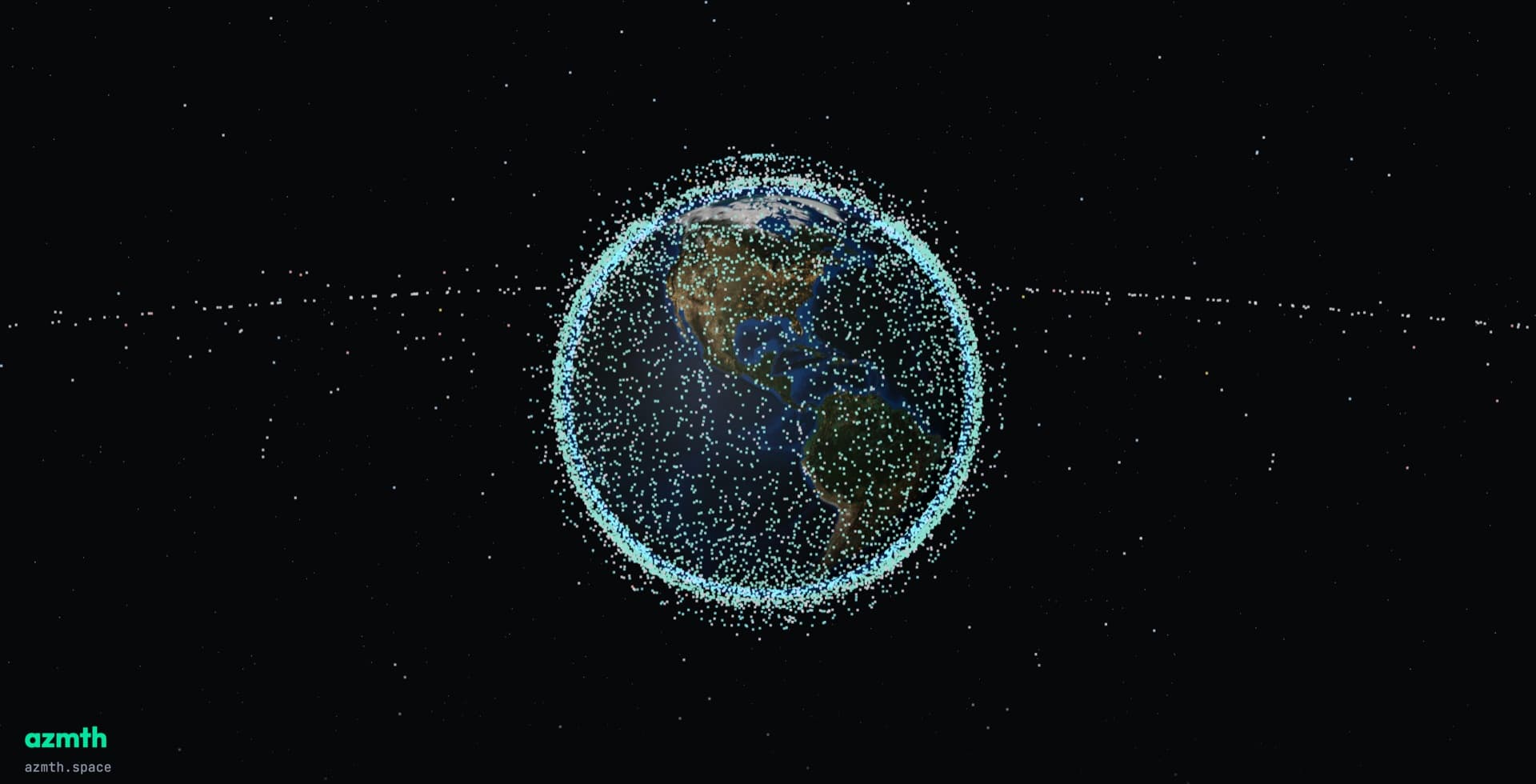
Some projects start with a business plan. azmth started with a much dumber question: I saw a line of lights crossing the night sky, figured out it was a Starlink train, and wanted to know what else was up there. The answer, it turns out, is about sixteen thousand things, and no website showed them to me the way I wanted: all of them, at once, moving, without asking me to sign up for anything.
So I built it. Next.js, Three.js, and a pile of orbital math I had no business touching. Every satellite with public orbital data, rendered live on a 3D globe, with positions calculated right in your browser using the same SGP4 propagation model the professionals use. No accounts. No ads. The data refreshes from CelesTrak every two hours, and pass predictions land within about thirty seconds of reality.
I shipped it in April. And then, for a while, absolutely nothing happened. No users. Just me, refreshing an analytics dashboard that had no news for me.
Then I posted it on Reddit
Eventually I did the thing I should have done on day one: I posted it to r/space. The post blew up. Over 50,000 views, shares everywhere, and a comment section full of enthusiastic strangers with genuinely great ideas, many of which I went on to build. People did not just want to look at the globe; they wanted to tell me what it should do next. I build for the people, it turns out.
The next day, azmth was in Morning Brew's newsletter, in front of millions of readers, in an issue called "Cash from the Sky". I found out the way you find out about most good things: confused, mid-scroll, saying "wait, that is my website" out loud to nobody.
The coverage kept arriving sideways from there:
- PCWorld featured it in a piece about satellite tracking. They did not technically call. It still counts.
- SmartBrief called it "rad", which I choose to take literally.
- Tangle described it as "a dizzying 3D map of every known satellite transmitting data in Earth's orbit".
- Kaminata, a Bulgarian tech blog, covered it for their readers. Free and no-signup, it turns out, translates into every language.
- Appinn, a popular Chinese software blog, wrote it up and sent a wave of visitors from China that never really stopped. I later self-hosted the fonts because the old font service was blocked there, and the first load in mainland China got dramatically faster. 欢迎中国朋友们!
- And my personal favourite: CONATEL and national media (Honduras). Honduras's national telecommunications regulator, CONATEL, runs azmth on its command-center wall display. It was on screen during the launch of the country's national Remote Technical Spectrum Verification System, which was covered by Honduras's national television and radio.
Nobody asked for this. That was the point.
I build client work all year: sites and products with goals, audiences, deadlines. azmth had none of that, which is exactly why it got good. When nobody is paying, the only reason to keep going is that the thing itself delights you, and that kind of care is visible in a product. People can tell when something was built because someone wanted it to exist.
The strangest proof: people started donating. I had added a buy-me-a-coffee button with zero expectations, basically as furniture, and strangers on the internet just kept buying me coffees for something they could use freely, without even an account. I still find that quietly moving.
Shipping in public, on repeat
After the first spike I kept a simple loop going: build the next thing people asked for, ship it, tell people about it. From the first public release in April to now, azmth went from a globe with dots to satellite detail pages, personalized pass predictions, Starlink train detection, orbit filters across 98 countries, a public dataset, an embed kit for news sites, and a "what was that in the sky?" identifier that tells you, honestly, when your UFO was actually Venus.
The clearest example of the loop working was True Scale: a cinematic view that shows any satellite at its actual size, with real NASA models for the ISS and Hubble, because the dots on every tracker (mine included) quietly lie about how small these things are. I posted it to Reddit, and azmth went viral a second time. People loved spinning the models around and discovering that a Starlink satellite is basically a flying table.
The numbers today, straight from analytics: in the last 28 days, over 14,000 active users and more than 230,000 tracked events, with well over a thousand visits on an ordinary day. Marketing budget to date: zero. Not every spike since has been people, though: in September 2026 one was a bot posing as tens of thousands of visitors from Singapore.
What I took from it
Four things, roughly. First, niche does not mean small: satellites are a niche, but "everyone mildly curious about space" is a lot of people. Second, removing friction is a growth strategy: no signup, no ads and no paywall is why newsletters could link it, a Chinese blog could recommend it, and a regulator could put it on a wall. Third, never underestimate Reddit: one honest post did more than any marketing I could have bought, and the comments became my roadmap. Building in public works because the public tells you what to build.
And fourth: craft compounds. Every small detail I polished for my own satisfaction became the reason someone else shared it. I still add features when the sky does something interesting. It remains, proudly, a thing nobody asked for.