Gorilla trekking in Uganda: what it cost us and how long it took (2026)
On 10 November we walked through the rain in Bwindi for four hours to reach the Kahungye gorilla family, who had spent the morning squaring up to another group of gorillas. The whole trek took about six hours. How the day went, what every part of it cost, and what changes if you go in November.
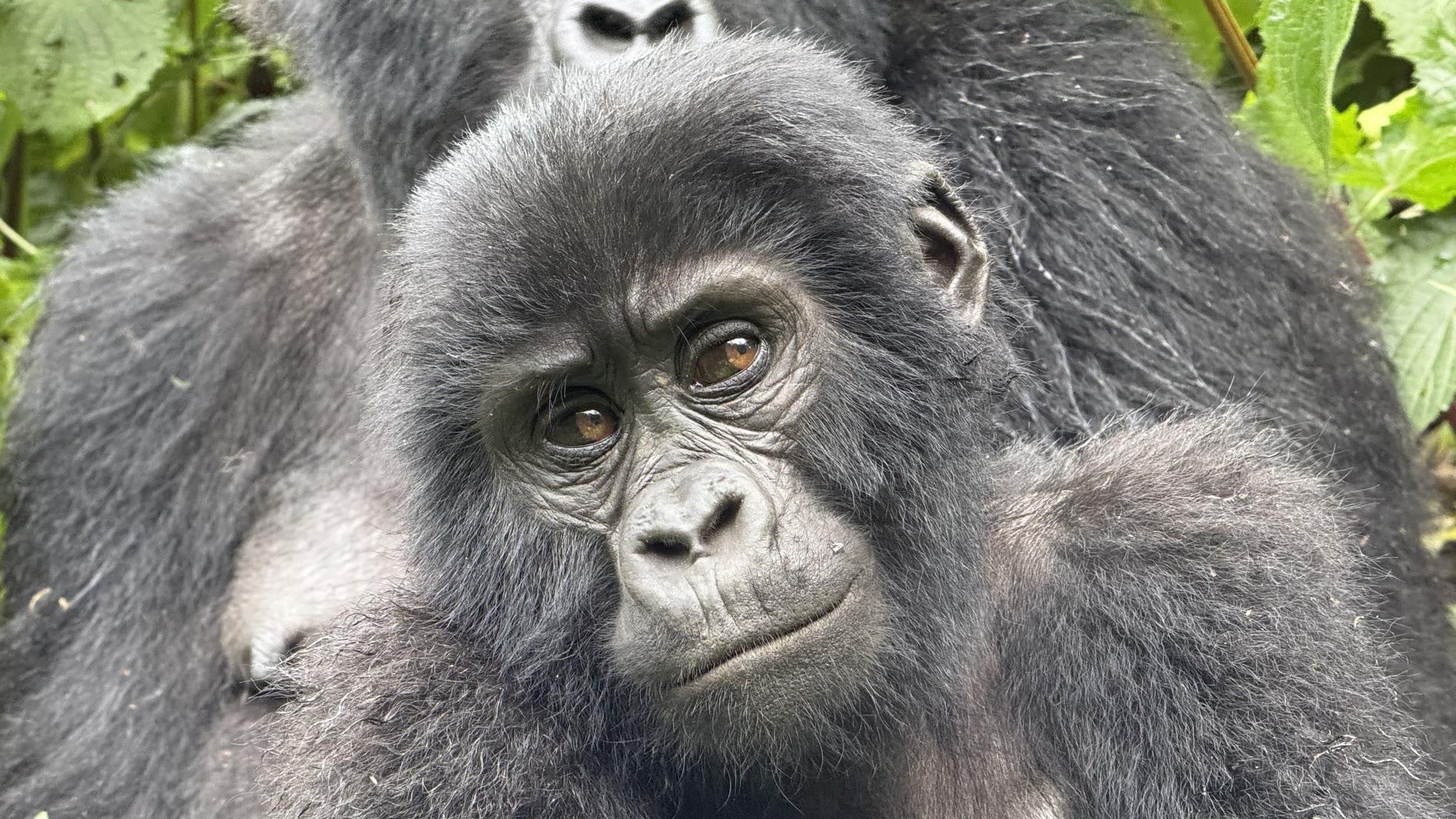
For foreign non-residents, a gorilla trekking permit in Uganda costs US$800. In 2026 it dropped to US$600 in April, May and November, but UWA's tariff from January 2027 lists no low-season price. We trekked in the Rushaga sector of Bwindi Impenetrable National Park on 10 November 2026 and paid US$650 each through a local operator: the US$600 permit and a US$50 fee. With the night bus, the lodge transfers, two nights at the lodge and food, the gorilla part of our trip came to about US$845 per person, or about €765 (full breakdown below).
The trek took about six hours. We started walking before 9 in the morning and didn't reach the gorillas until almost 1 in the afternoon, which made us the unlucky group that took the longest.
How we got to Rushaga
We flew from Budapest to Entebbe for €300 each and spent two days around Entebbe first: the botanic gardens, Lake Victoria, and Mabamba swamp to look for shoebills. Then a night bus from Kampala to Kisoro, €14 each.
Our lodge, Nshongi Camp, is a five-minute walk from the edge of Bwindi, and the staff were lovely, sweet and helpful. They picked us up in Kisoro and, two days later, dropped us at the Cyanika border to cross into Rwanda. The transfers cost €130 for the two of us and two nights cost €140. No meals were included, so we paid for six: two full dinners, a packed lunch, a breakfast, snacks and a fruit salad. With drinks, that came to US$60 for both of us.
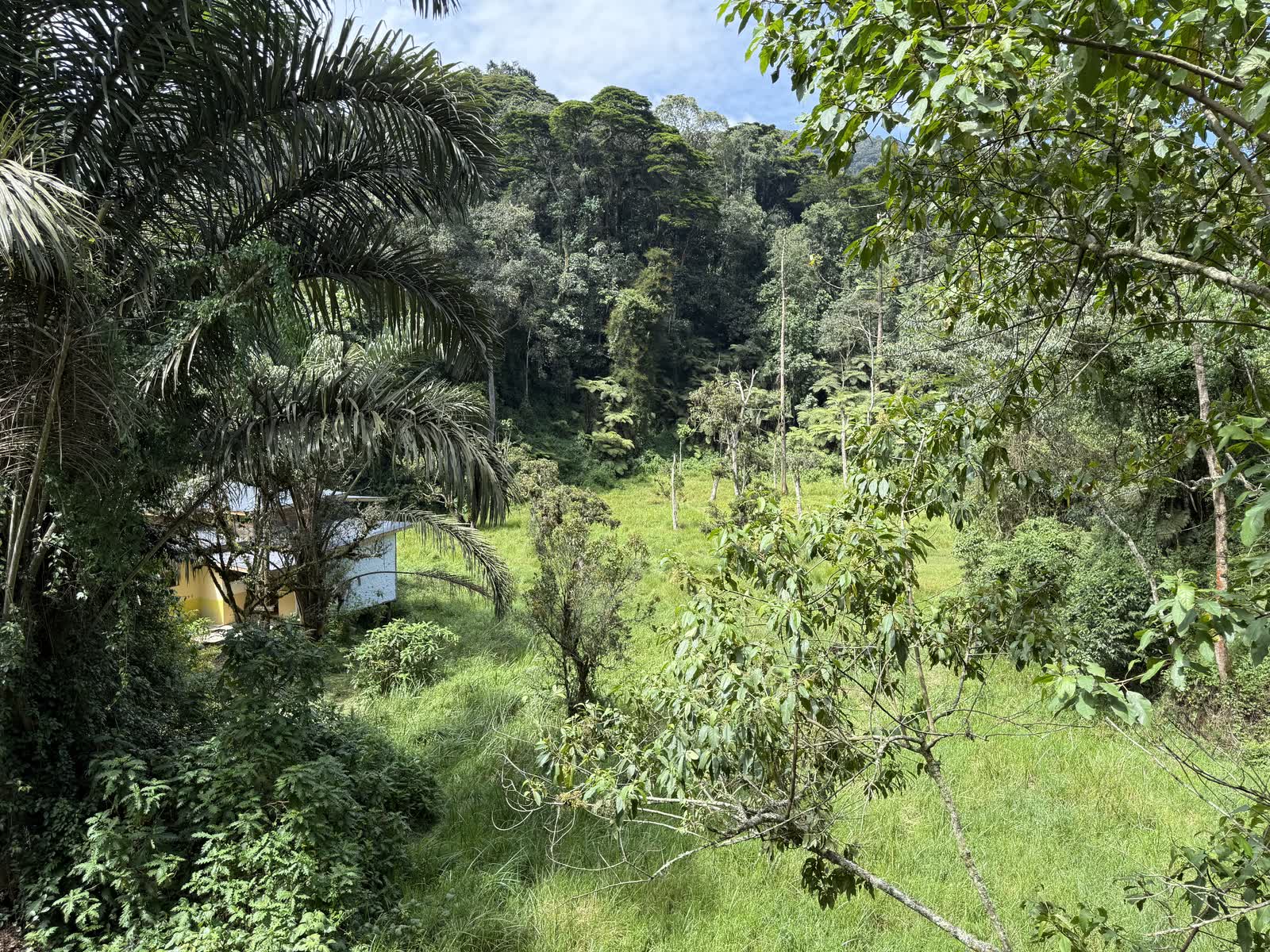
We booked the permits through Likana Safaris Uganda in October. Foreign non-residents don't have much choice here: the Uganda Wildlife Authority (UWA) only sells them gorilla permits through licensed tour operators. Likana sent a payment link, we paid by card, and they were great. Bonny, our contact there, always answered fast and was really nice and attentive, even though we never met in person. One thing to know: don't worry if the permit takes its time. Ours arrived three days before the trek, and everything went fine.
The morning briefing at Rushaga
The day started around 7:30 at the Rushaga office. More than thirty people turned up, so the rangers split everyone into groups of up to eight and gave each one a gorilla family. There was a welcome dance by women in green with baskets on their heads, and then our guide briefed us next to a small sign that said KAHUNGYE GROUP. Everyone was handed a walking stick.
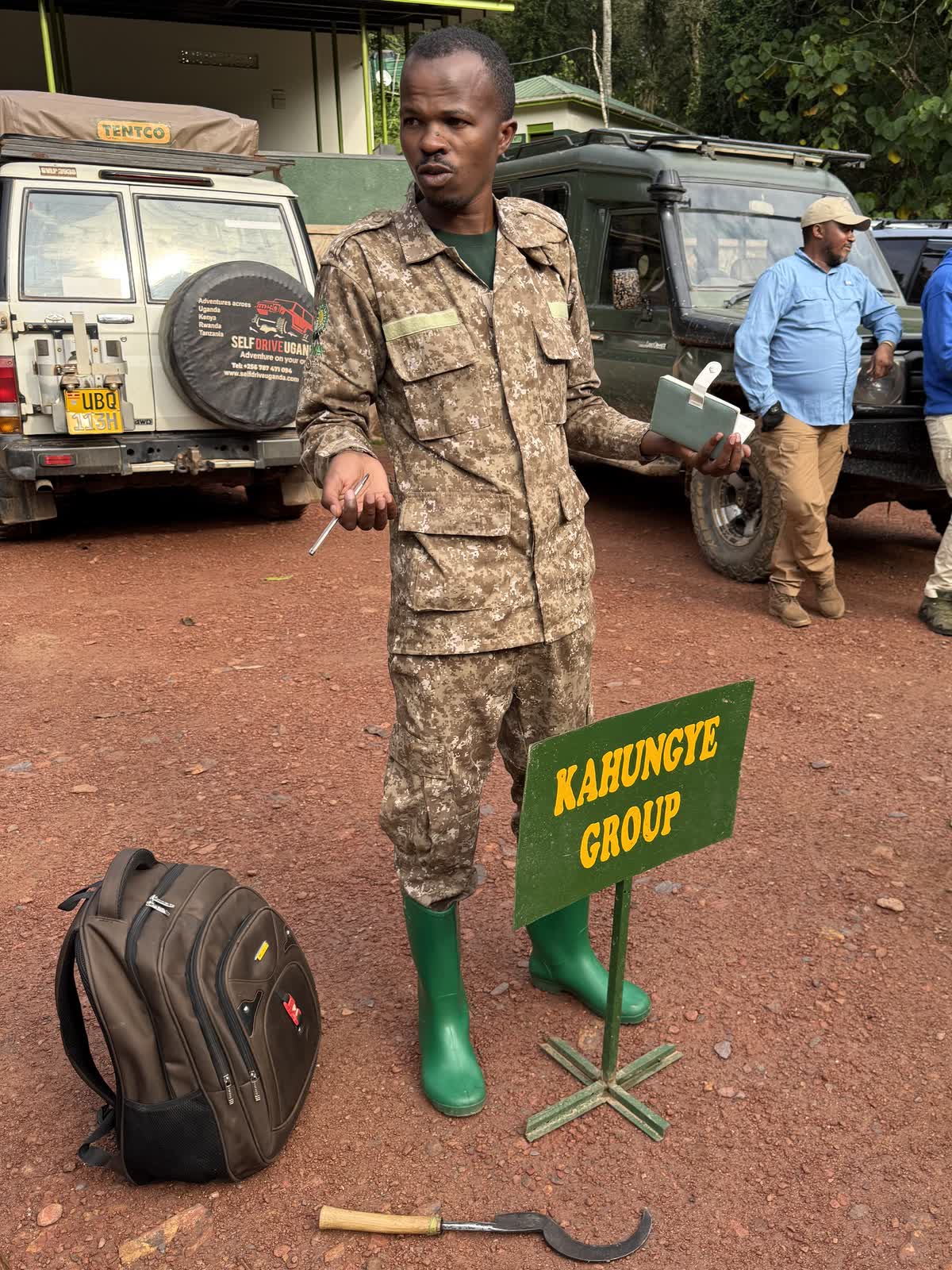
There were eight of us: two women from Germany, a couple from Spain, an older couple from Zimbabwe who live in France, Anna and me. We were one of the youngest groups there, and the older ones probably got the easier families.
We had a ranger guide and two armed rangers, one at the front and one at the back. The trackers had set off before any of us. They start at dawn from where the family slept the night before, follow the trail until they find them, then call the guide.
Why it took four hours to reach the gorillas
We set off at around half past 8. It had rained before we started, it rained again during the trek, and it was still raining on the way back. Rushaga is all hills, so the path goes steeply up, steeply down, then up again. We had bought gaiters for the trip and were glad of them all day. It was hard going, but I never thought about turning back.
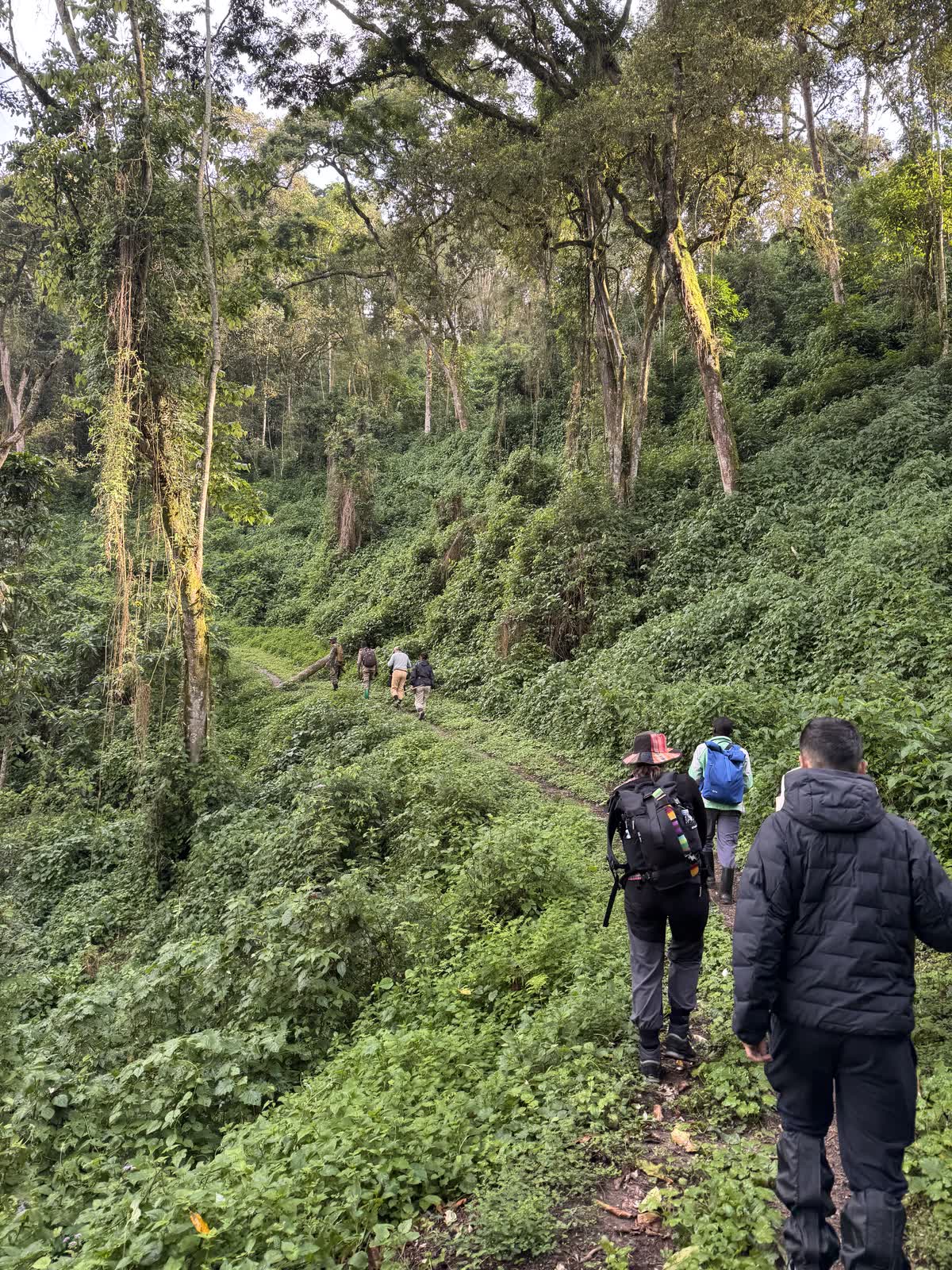
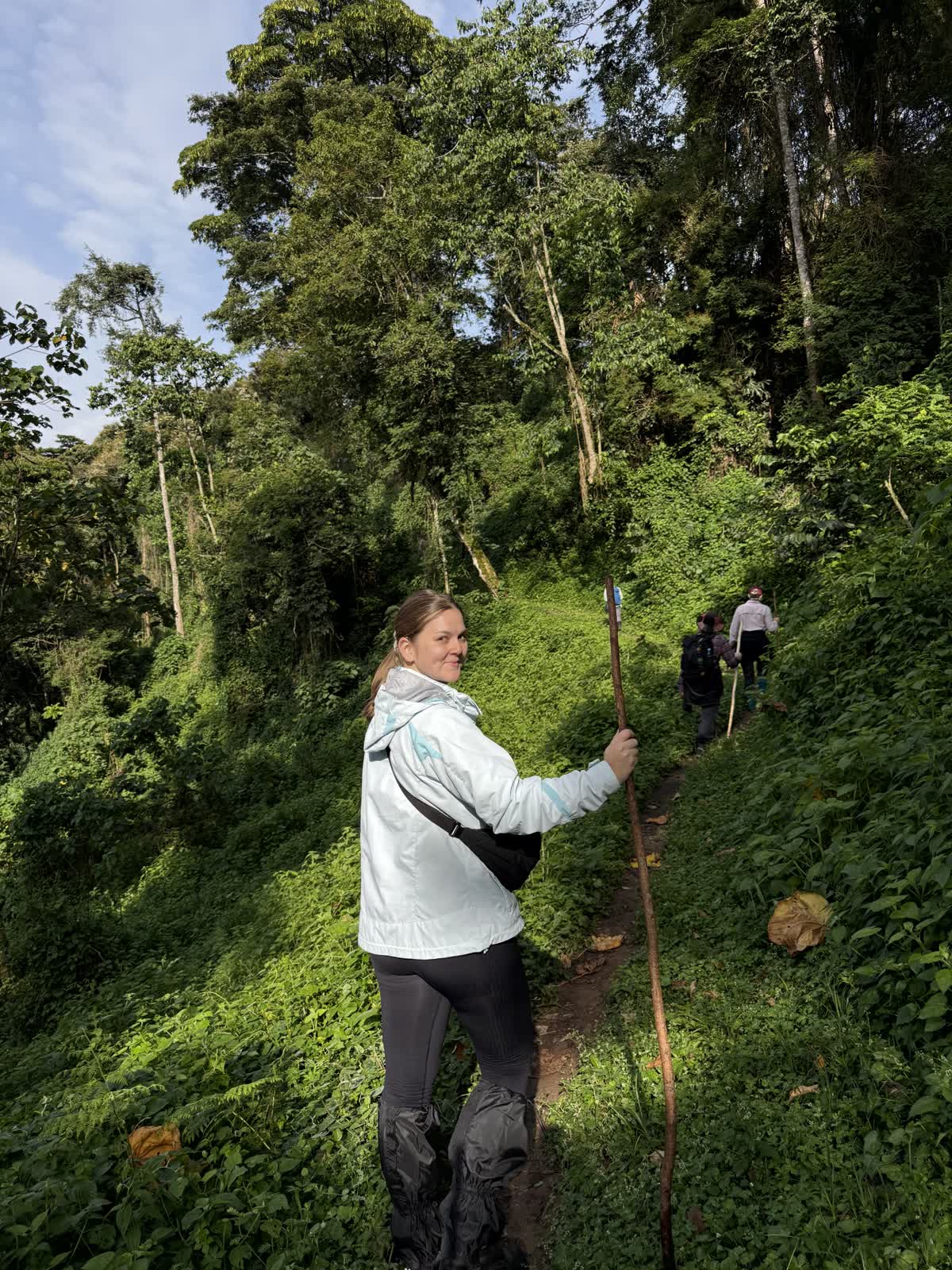
For the first hours we went around like headless chickens, and the GPS in our photos agrees. By mid-morning we were 1.3 km from the start, at about 2,140 m, the highest point of the day. An hour later we were only 1 km away, and going nowhere.
The holdup was the gorillas themselves. Our guide was on the phone with the trackers the whole time, and the news wasn't good: the Kahungye family had run into another group of gorillas, one that wasn't habituated to people yet, and it looked like it would end in a fight. All of it happened somewhere ahead of us in the forest, out of sight and out of earshot. We waited, moved, and waited again while it played out, until the trackers stepped in and the two groups went their separate ways.
So for most of those four hours we weren't walking at all. We stood around on a hillside, once for the best part of two hours, under trees thick enough to keep most of the rain off. That meant a lot of pee breaks and a lot of talking, and it was long enough to get to know six strangers properly.
| Time | Altitude | From the trailhead | Moment |
|---|---|---|---|
| 08:40 | 1,910 m | 0 km | Off we go |
| 08:44 | 1,930 m | 250 m | Looking for them |
| 08:49 | 1,940 m | 400 m | Looking for them |
| 08:53 | 1,980 m | 500 m | Still feels like a walk |
| 09:13 | 2,080 m | 800 m | Looking for them |
| 10:20 | 2,140 m | 1.3 km | Highest point of the day. No gorillas. |
| 10:30 | 2,090 m | 1.3 km | Looking for them |
| 11:35 | 2,060 m | 1 km | Waiting under the trees, going nowhere |
| 12:56 | 2,010 m | 1.25 km | Gorillas! |
| 13:10 | 2,000 m | 1.25 km | With them |
| 13:25 | 2,010 m | 1.2 km | With them |
| 13:40 | 2,010 m | 1.2 km | With them |
| 13:55 | 2,000 m | 1.2 km | Last gorilla photo |
| 14:48 | 1,850 m | 250 m | Back at the lodge |
Around noon the call we were waiting for finally came: the family had stopped in one place. We walked again, and just before 13h the guide stopped us, had us leave our walking sticks behind and put our masks on. A few steps later, there they were. By then we had walked more than 4 km to end up 1.2 km from where we started, as the crow flies.
It doesn't always go like this. The rangers told us about groups that found their family in 30 minutes, had their hour and walked out. We were just very unlucky.
A little over an hour with the Kahungye family
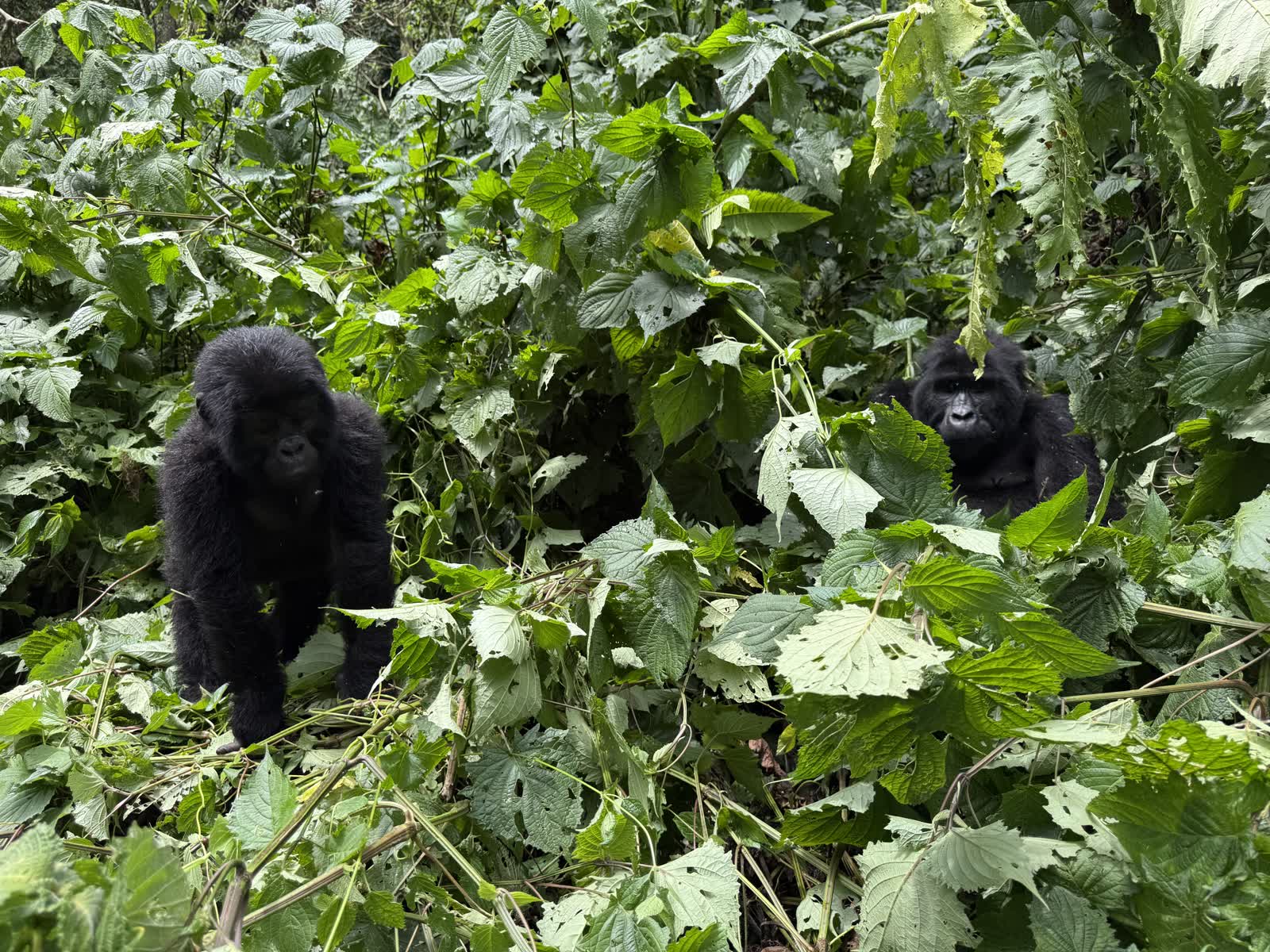
Visitors are meant to keep 10 metres away. Nobody had told the gorillas. They ran up and down the slope much closer than that, right past us, while we stood still in the middle of their lunch. In a zoo there is glass between you and them. Here there were a few leaves, and they mostly paid us about as much attention as the walking sticks we had left behind.
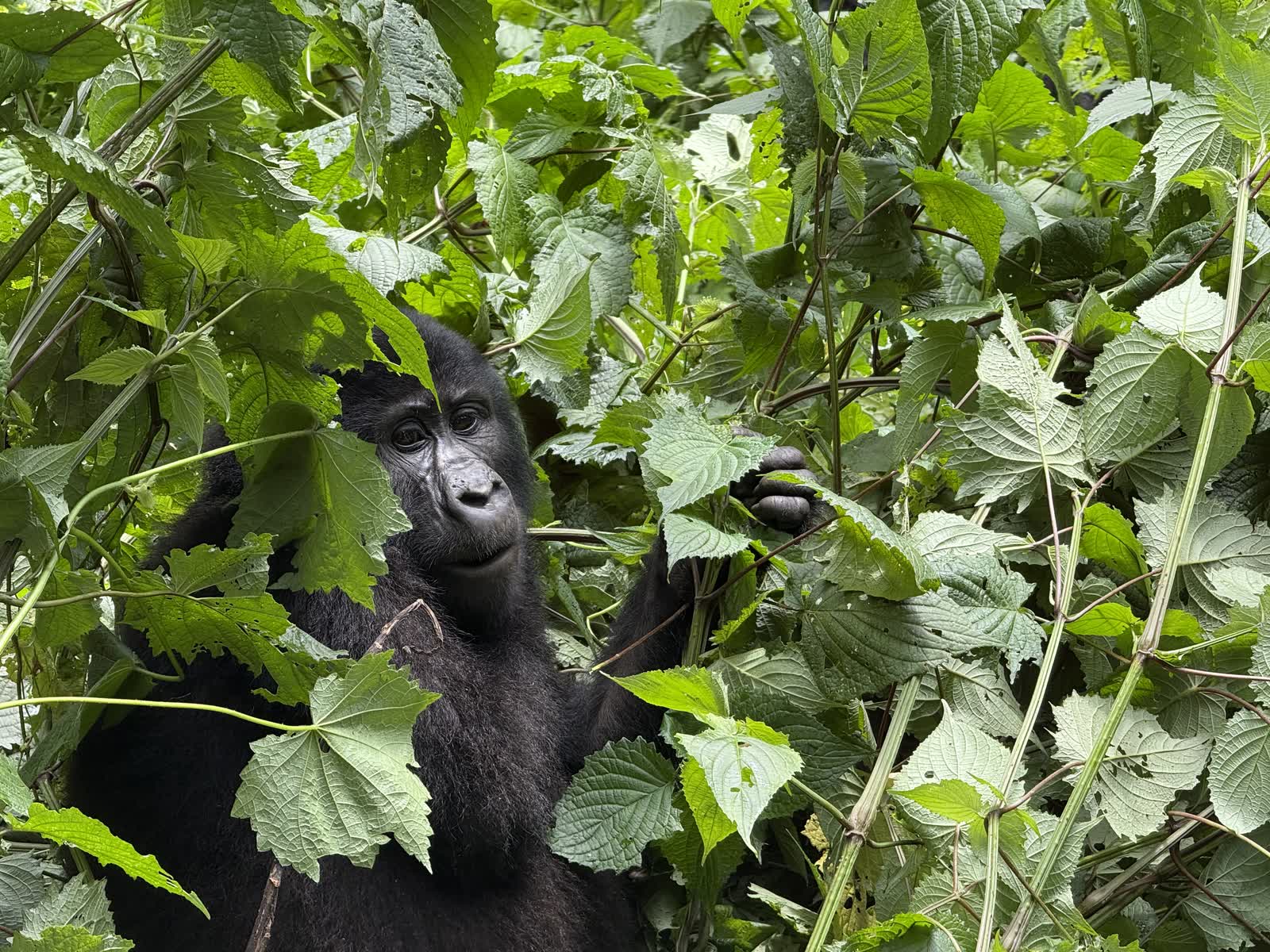
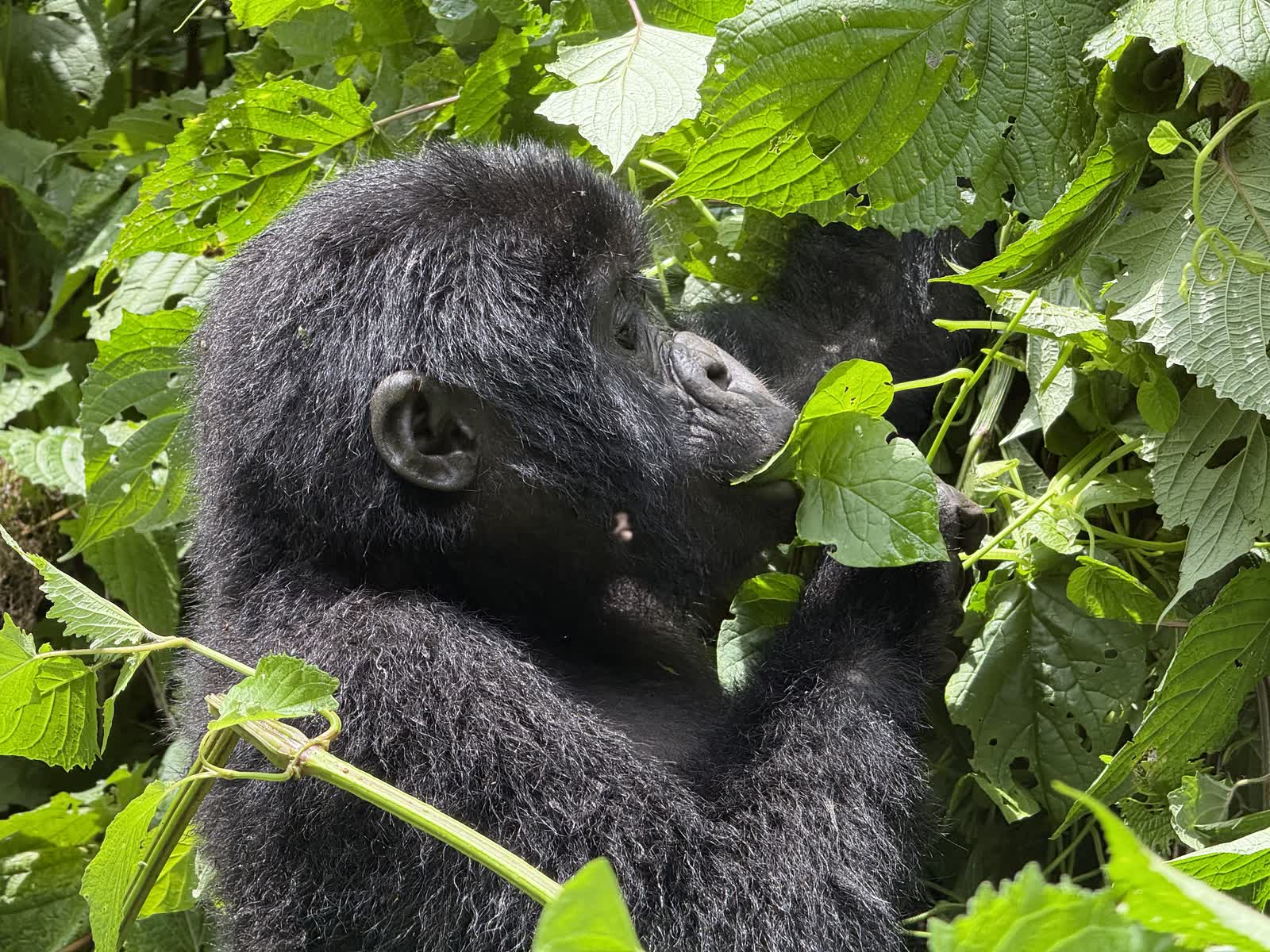
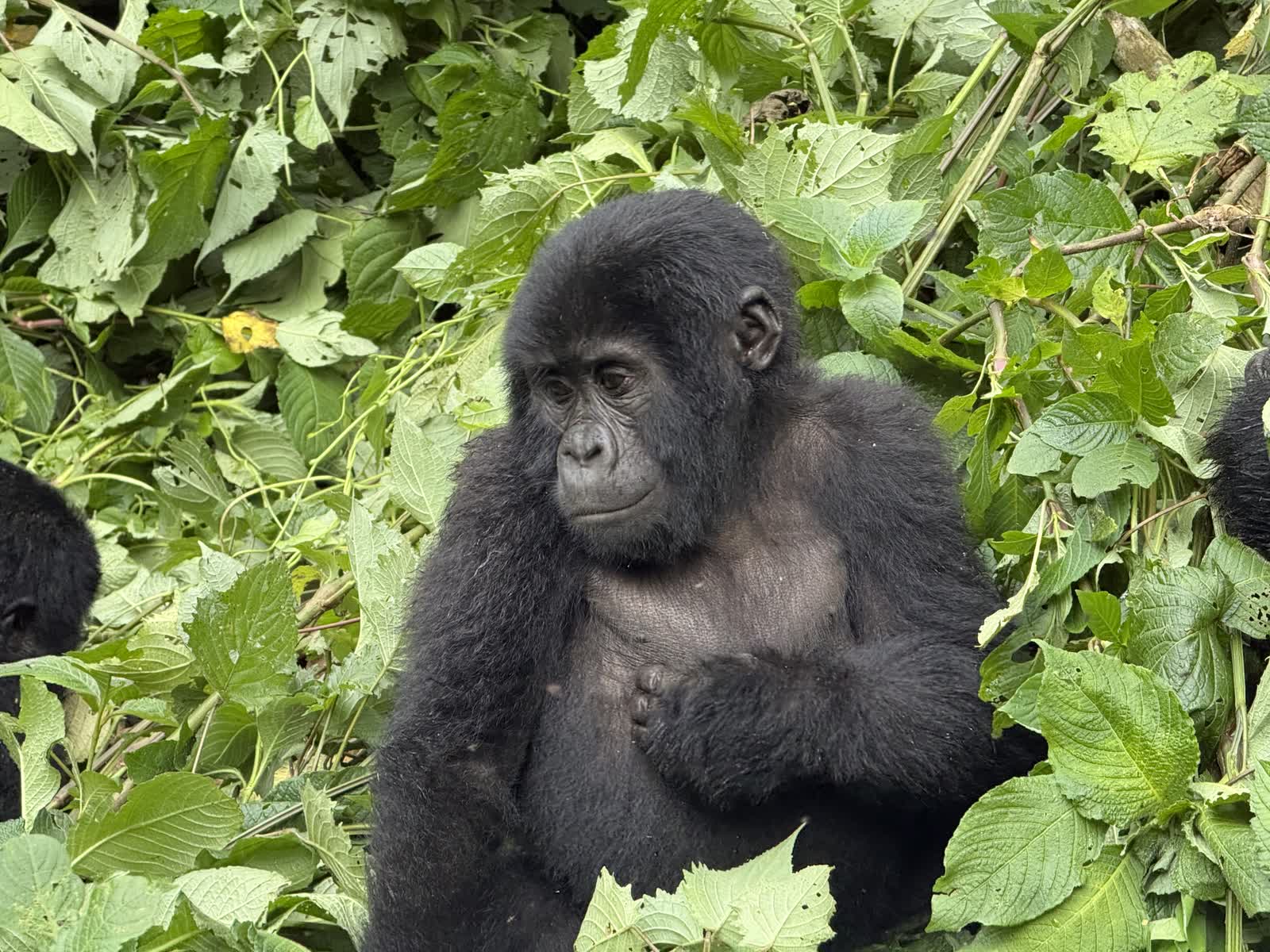
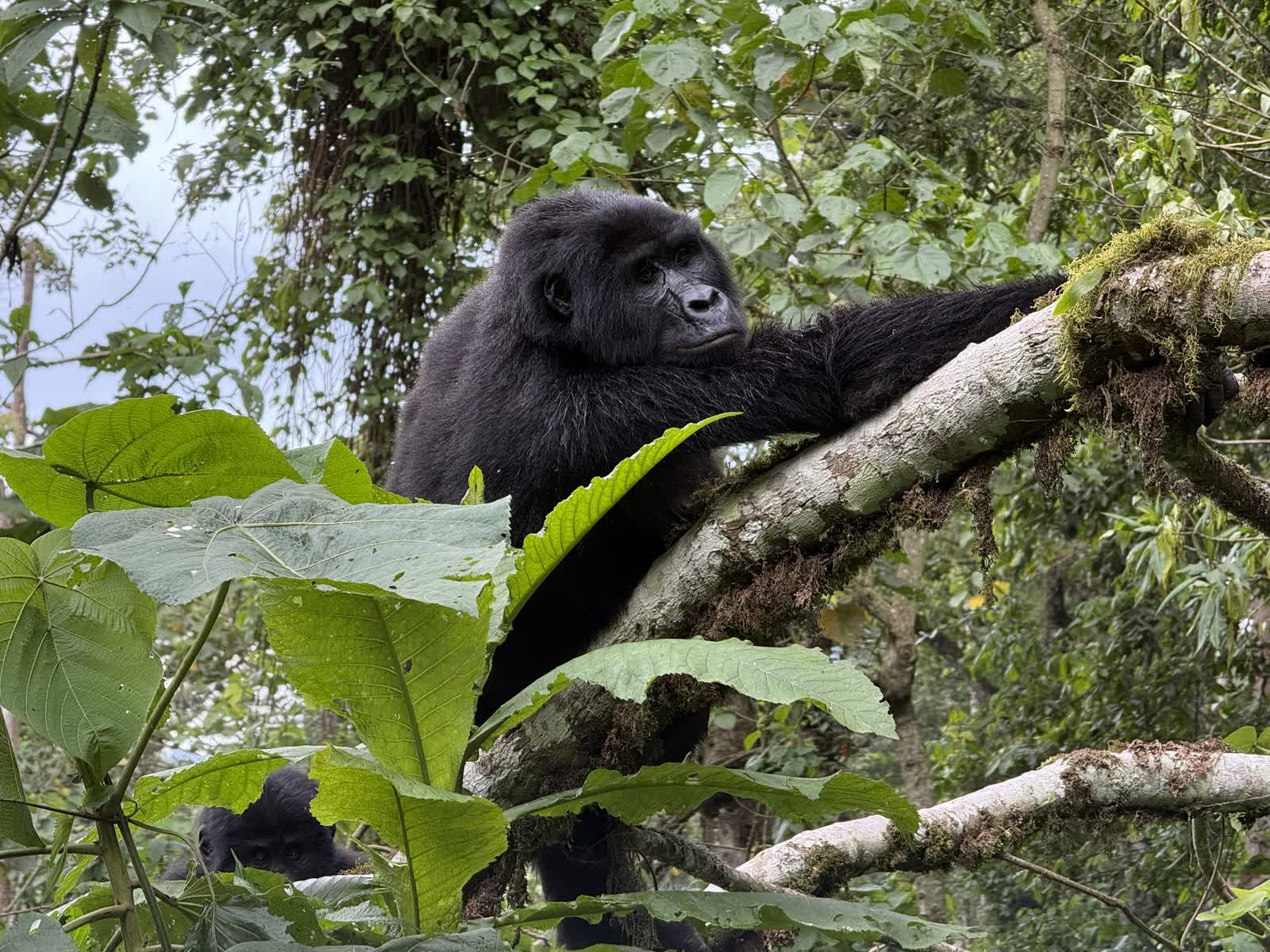
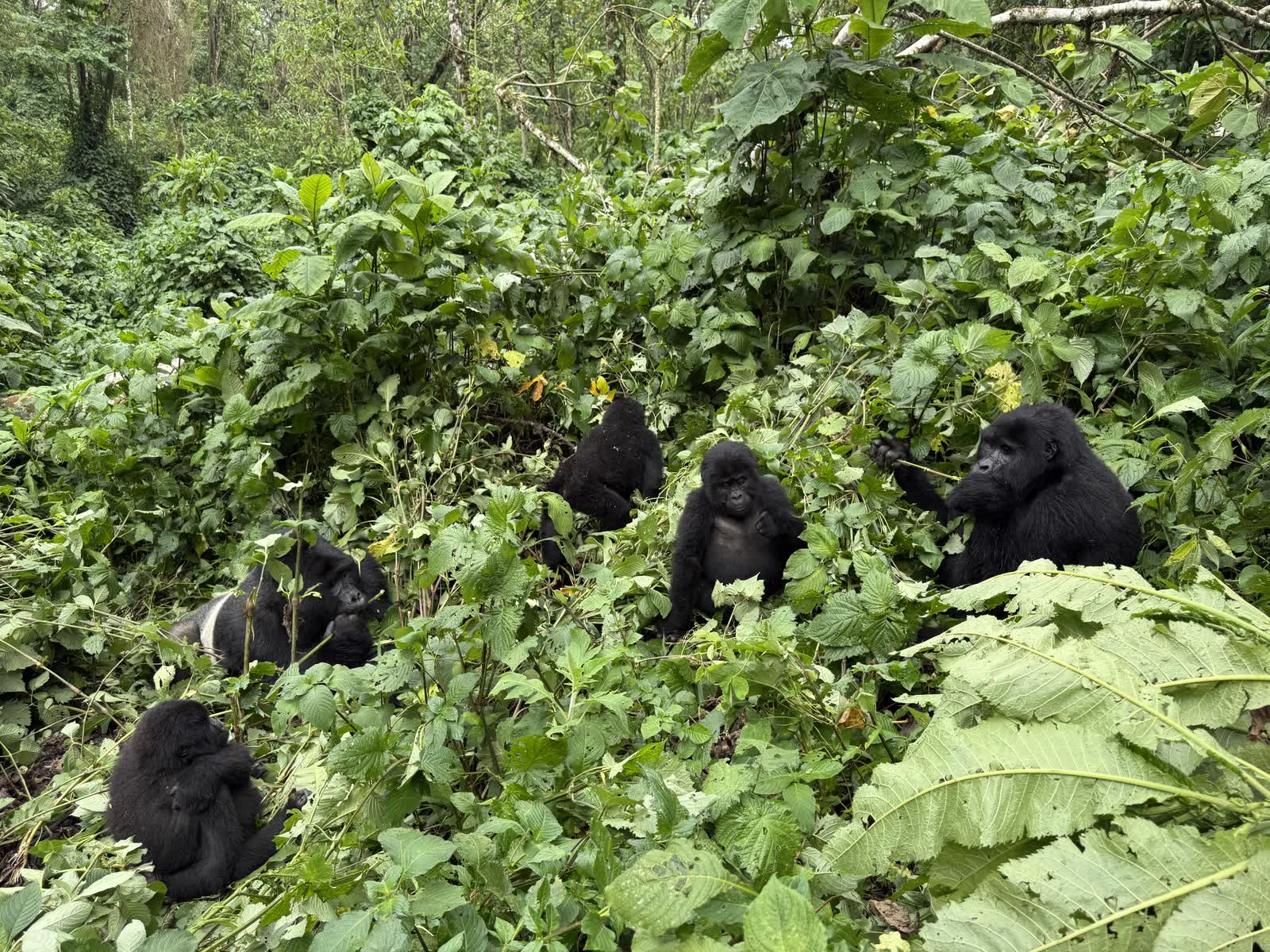
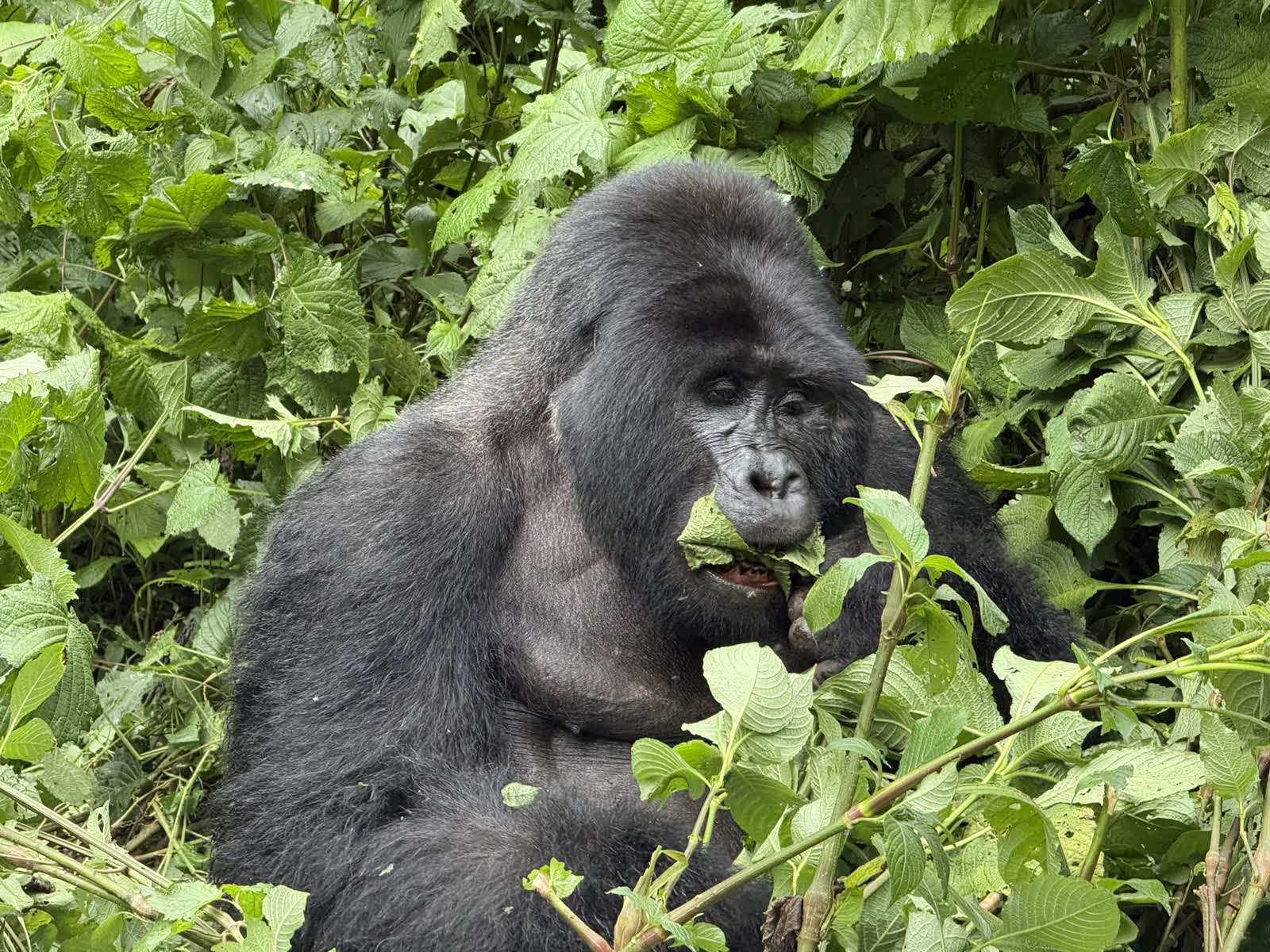
The silverback was busy eating, sitting side-on to us and pulling stems towards his mouth.
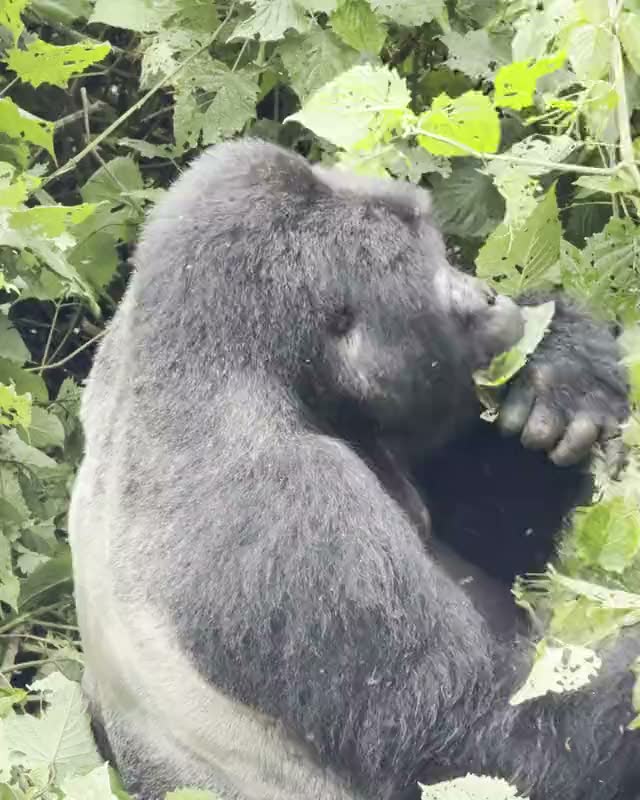
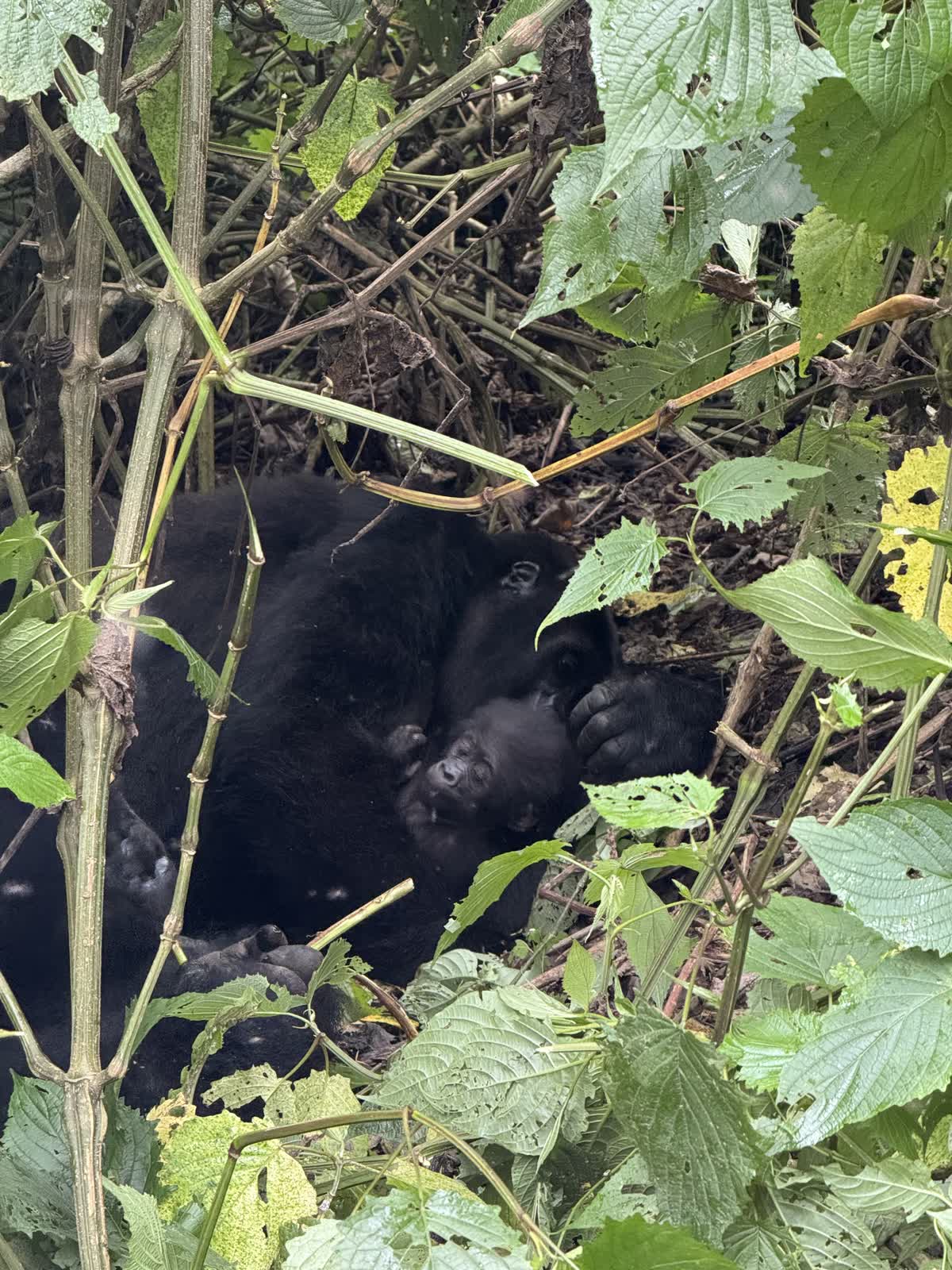
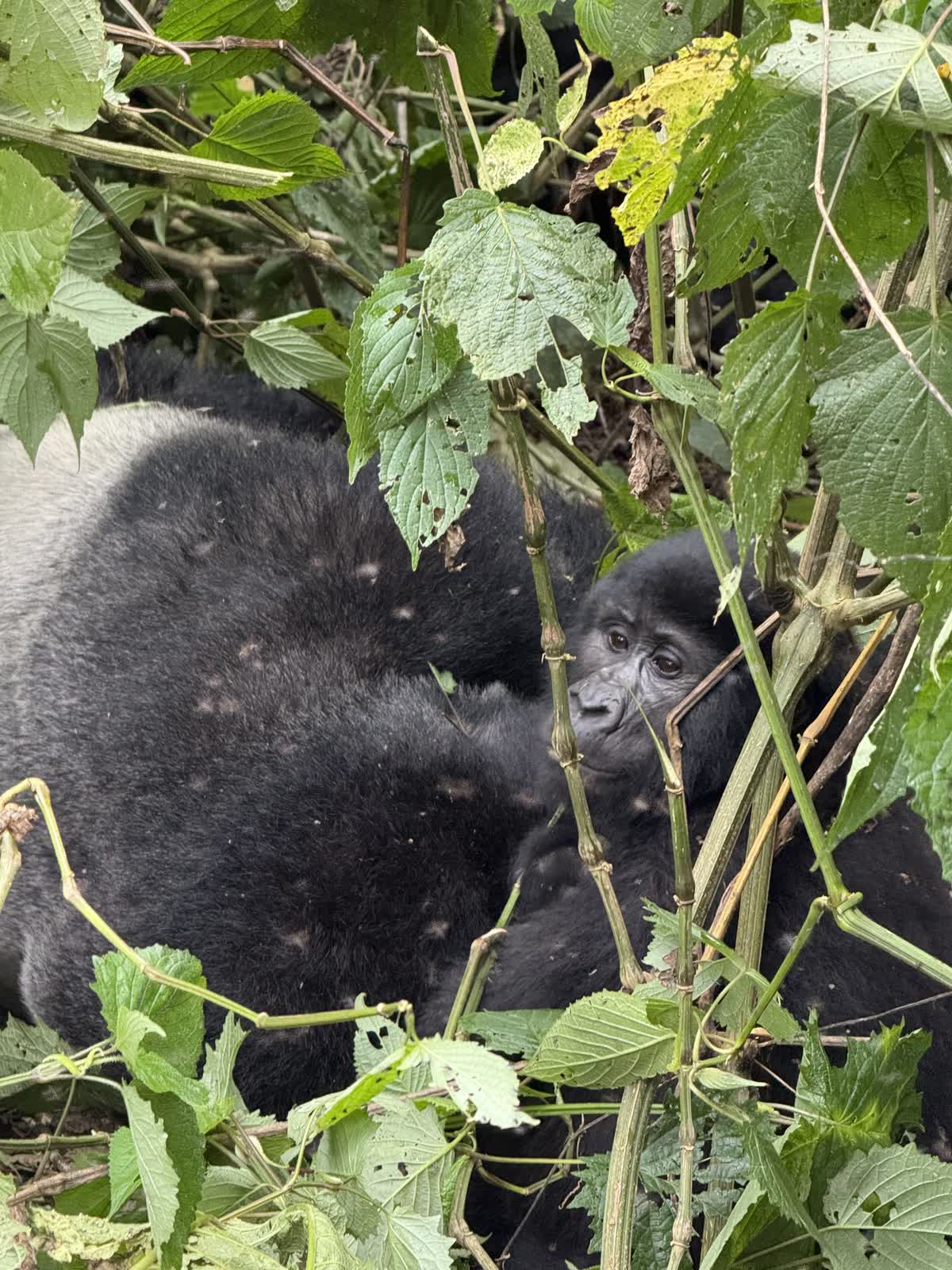
A mother lay back in a nest of flattened stems with a tiny infant on her chest. A little later another infant was tucked against the silverback's side.
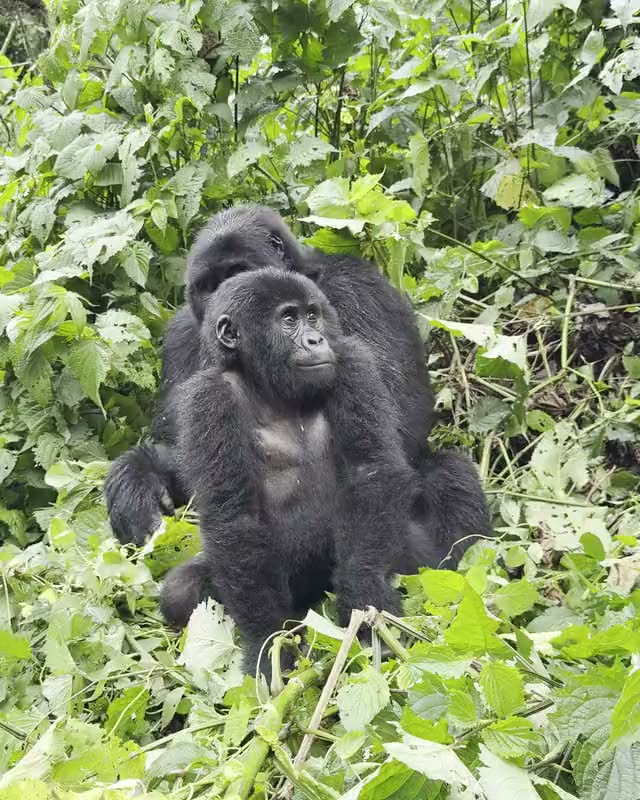
The juveniles climbed everything, hung off branches by one arm, and one of them fell straight off the top of a bush.
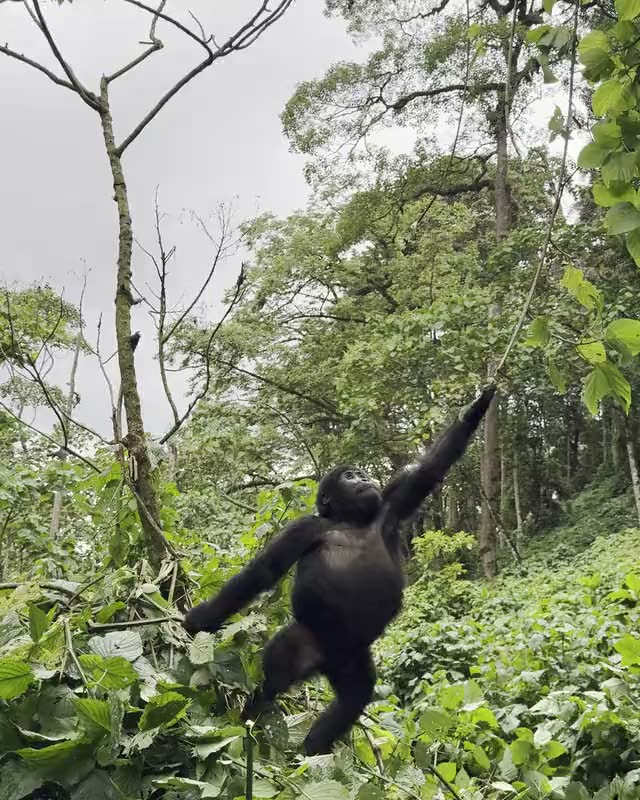
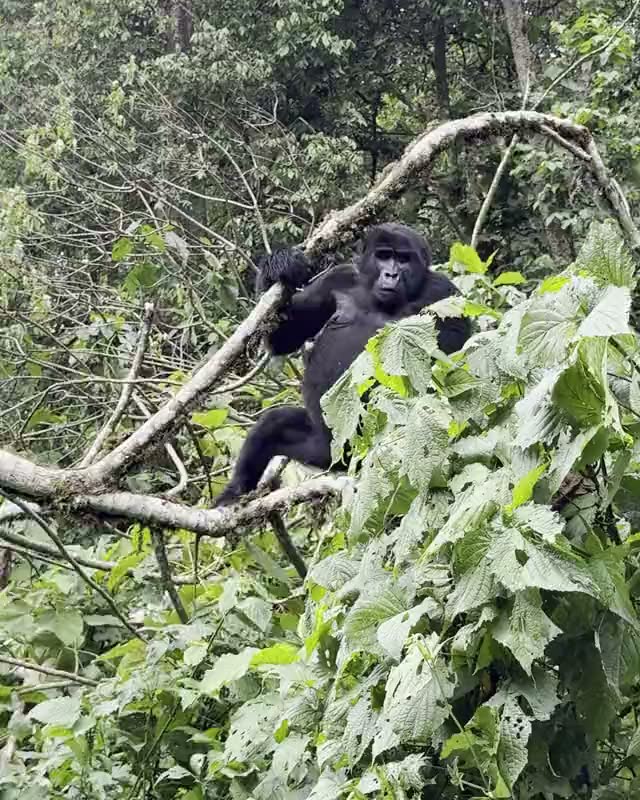
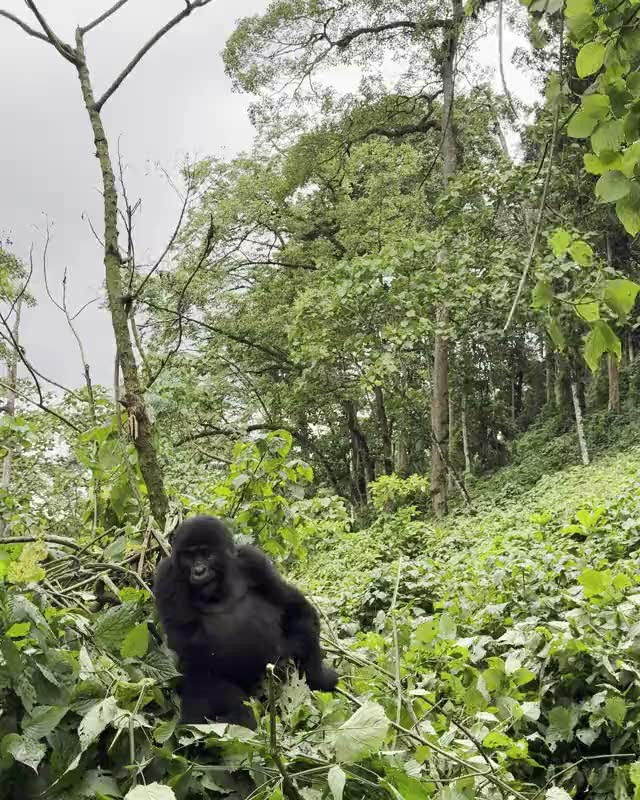
We got a few pics of ourselves too, with the gorillas carrying on behind us.
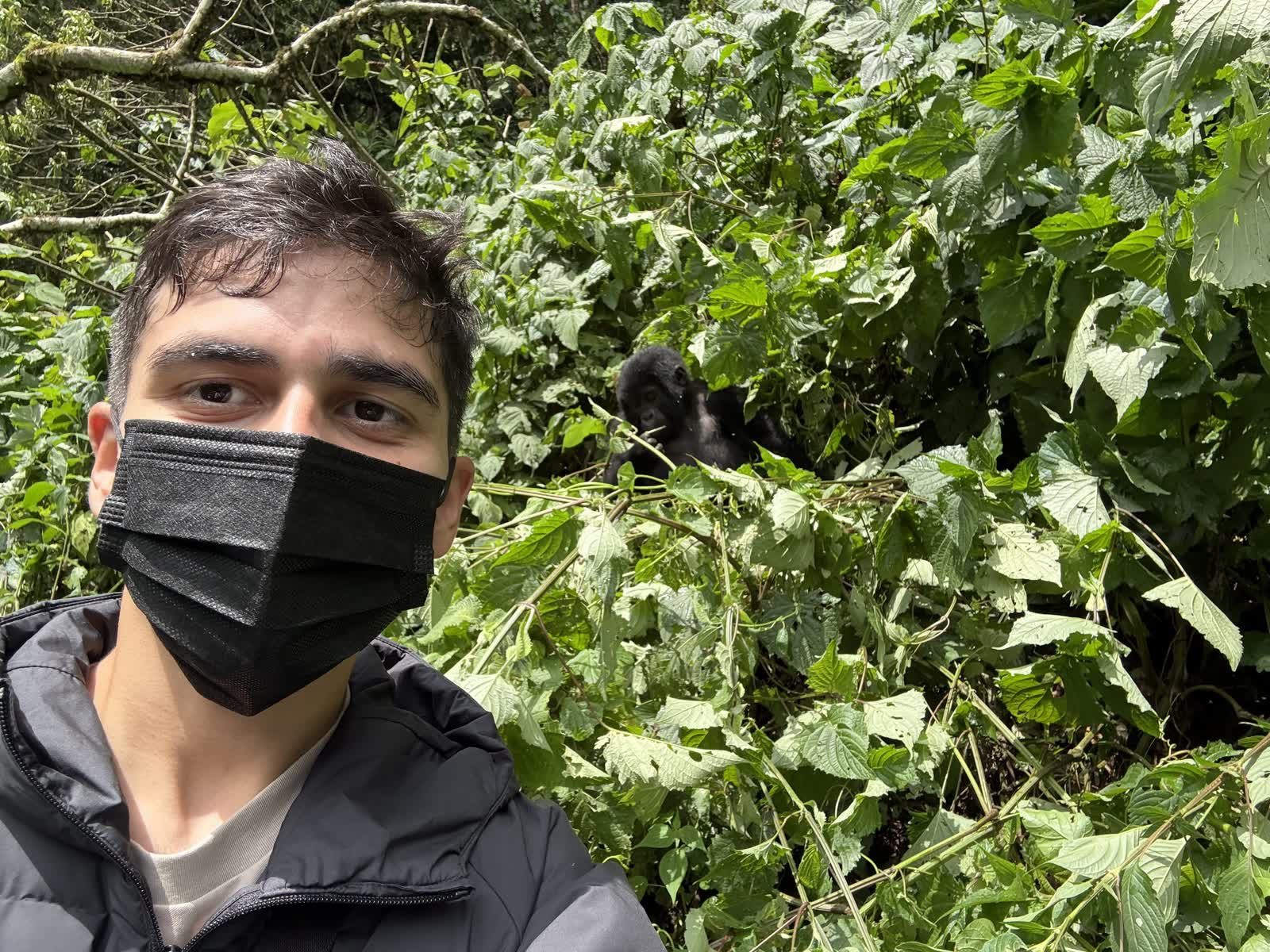
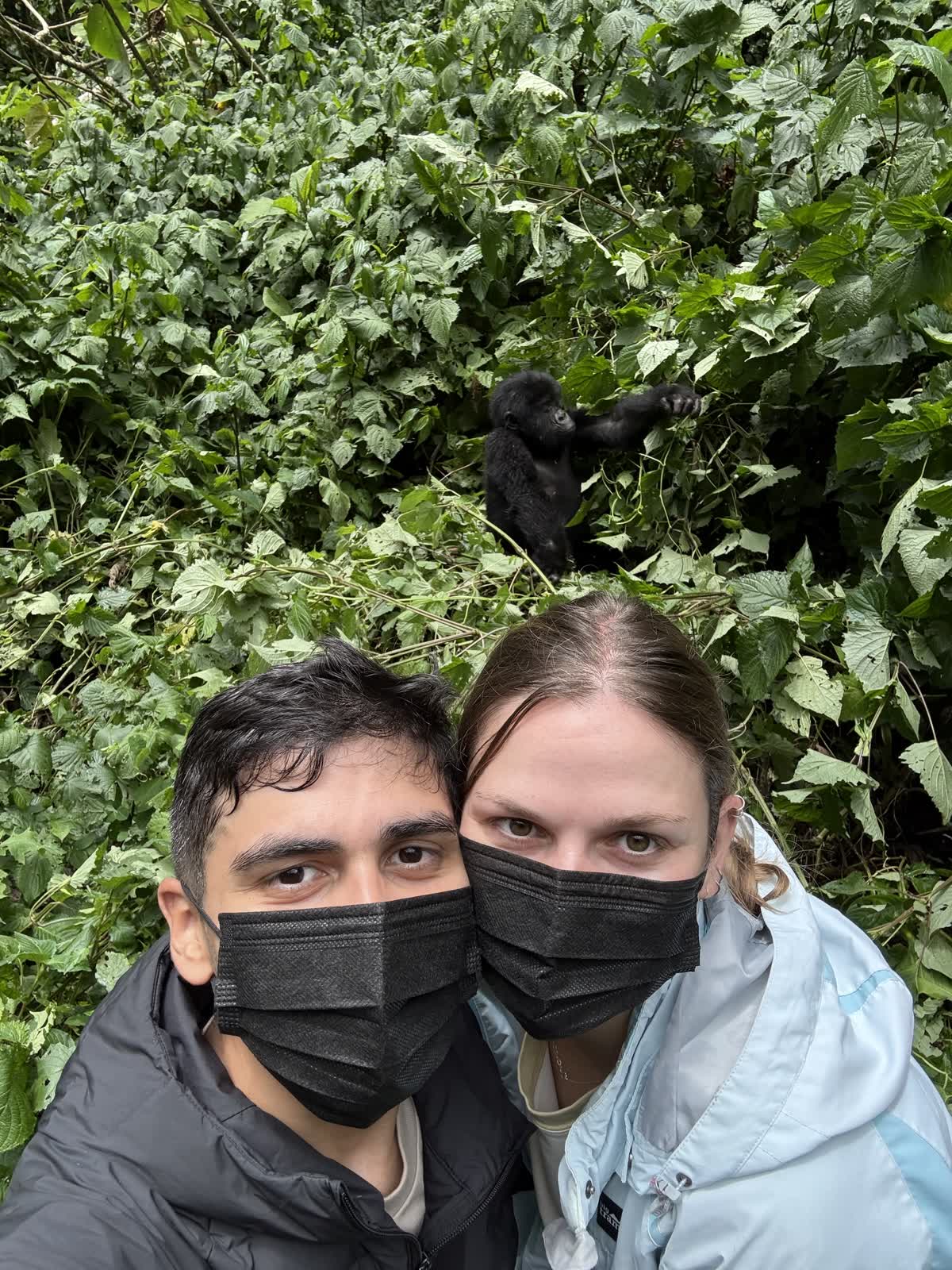
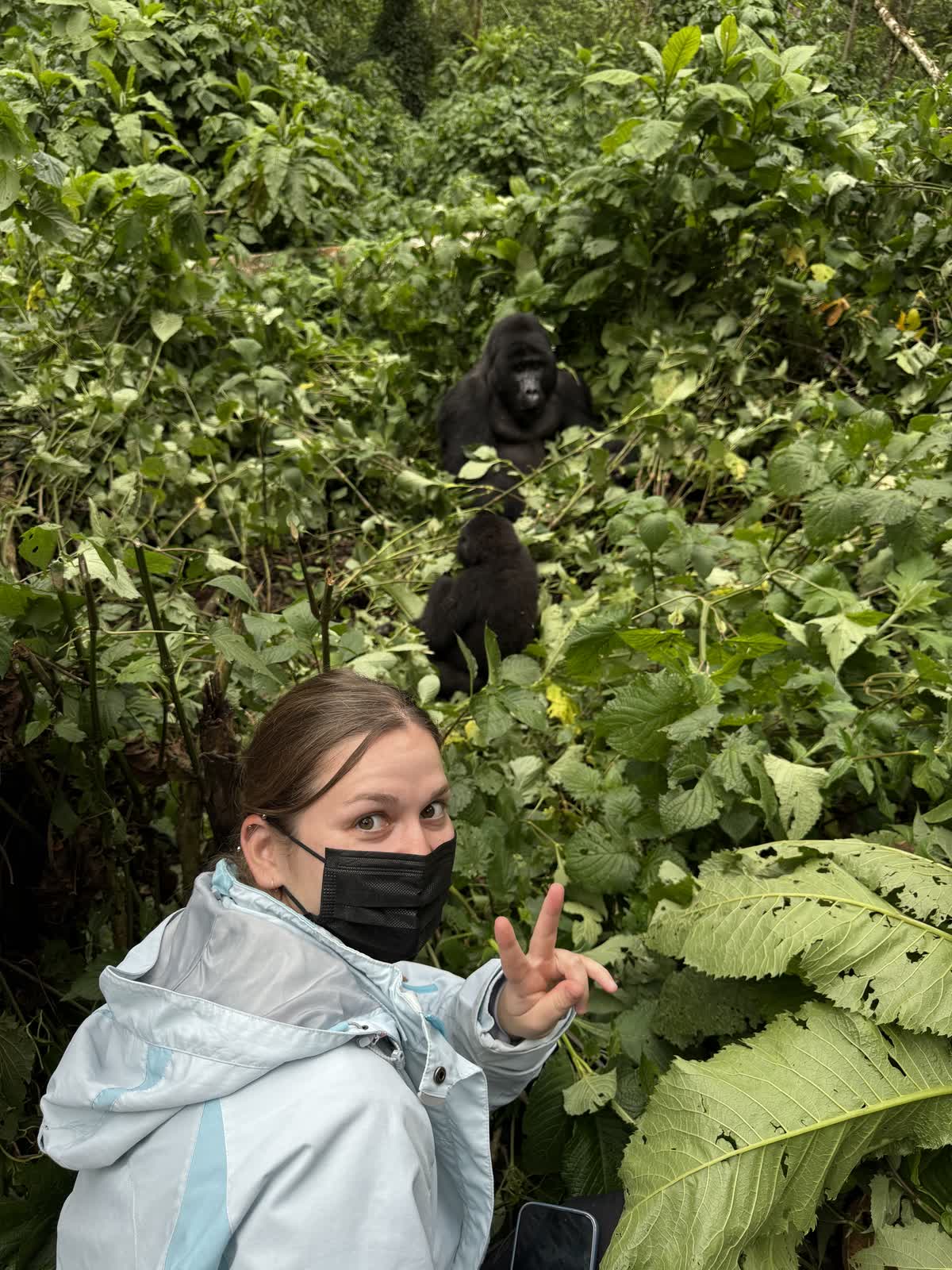
Visits are capped at one hour, and after that morning we got a bit of extra time. Divided out, the permit cost about US$10 a minute with the gorillas. The four hours of looking came free.
The way back took under an hour
Going back, we knew the way. We left the family just before 14h and were back at the lodge before 15h. Four hours to get in, under one to get out.
It was still raining, and the steep descents had turned to mud. I slipped on one of them, not badly: I caught myself on my hand and kept going.
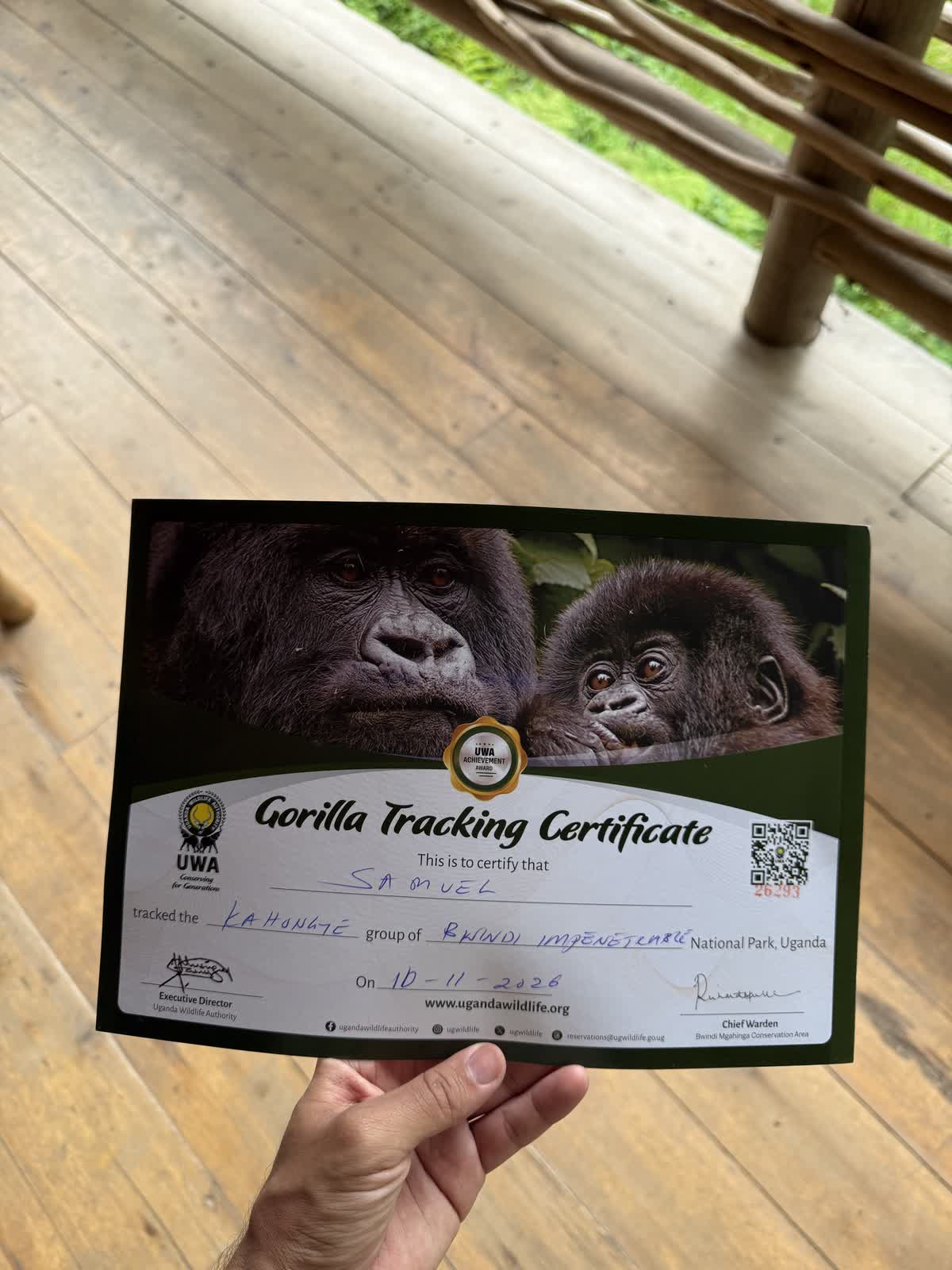
After the trek everyone gets a certificate with their name, the date and the family. Ours says Kahungye.
What gorilla trekking in Uganda cost us
| What | Paid | Each |
|---|---|---|
| Gorilla permit (UWA, November price) | US$600 each | US$600 |
| Operator fee (Likana Safaris Uganda) | US$50 each | US$50 |
| Night bus, Kampala to Kisoro | €14 each | €14 |
| Lodge transfers: Kisoro to Nshongi Camp, later to the Cyanika border | €130 for two | €65 |
| Nshongi Camp, 2 nights, room only | €140 for two | €70 |
| Six meals at the lodge (two dinners, a packed lunch, a breakfast, snacks, a fruit salad) and drinks | US$60 for two | US$30 |
| Porter | None | US$0 |
| The gorilla part of the trip | US$680 + €149 | |
| All in US dollars | about US$845 | |
| All in euros | about €765 |
Totals converted at €1 = US$1.10, the rate in November 2026. Prices checked on 22 November 2026. From January 2027, UWA's new tariff keeps the permit at US$800 and lists no low-season price, so don't count on US$600 in 2027.
Not included above: flights from Budapest to Entebbe (€300 each), the East Africa Tourist Visa (US$100 each, covering Uganda, Rwanda and Kenya), the yellow fever vaccine and the gaiters.
Was it worth it?
If you have the money to spare, yes. It was tiring, and we would still do the day exactly the same way.
If you don't, you can always try your luck. The day we arrived at Nshongi Camp, the staff showed us photos they had taken the day before, when a gorilla family wandered right past the lodge. That sighting cost them nothing.
Before you book
- November is wet, and in 2026 it was also cheap: the US$600 price for foreign non-residents applied in April, May and November, the rainy months. UWA's tariff from January 2027 doesn't list a low-season price, so check before you plan around one. Since February 2026, low-season permits can't be rescheduled, and since March every permit has to be paid in full when you book.
- Book through a licensed operator, and don't leave it to the last week. We booked in October for 10 November. The permit itself can arrive late: ours came three days before the trek.
- Pick your sector by your route. Bwindi has four trekking sectors, and Rushaga, in the south, suited ours: we came in by bus through Kisoro and left for Rwanda through the Cyanika border.
- Plan for a full day. UWA says a gorilla trek takes two to seven hours. Ours took about six from the trailhead and back. Families are given out at the briefing, so mention it there if a long, steep walk worries you. Children under 15 can't go.
- Bring water and snacks. We only had a sling bag with water bottles.
- Buy gaiters. They keep the mud and the rain out of your boots. The rest doesn't need to be fancy: I wore a light Uniqlo jacket, and everyone gets a walking stick at the briefing.
- Bring the yellow fever certificate. It is officially required to enter Uganda. Ours was never checked, which is not a reason to leave it at home.
- If you are also going to Rwanda, get the East Africa Tourist Visa: US$100, 90 days, Uganda, Rwanda and Kenya.
- We didn't hire a porter and were fine with a light bag. If you're carrying a camera bag or anything heavy, ask about a porter at the briefing.
One day I'd like to try the habituation experience: up to four hours with a family that is still getting used to people, for US$1,500, rising to US$1,800 in January 2027. Maybe when I'm richer.
Rwanda came next on that trip, but not for the gorillas: a permit there costs at least US$1,500, which is why we did them in Uganda. In Rwanda we went to see the golden monkeys instead (US$100). That one is a story for another day.
Gorilla trekking in Uganda, quickly
How much does gorilla trekking in Uganda cost?
The permit is US$800 for foreign non-residents, US$700 for foreign residents and US$500 for visitors from the rest of Africa. In April, May and November 2026 it drops to US$600 for foreign non-residents. UWA's tariff for January 2027 to June 2028 keeps US$800 and lists no low-season price. Booking through an operator adds a fee (ours was US$50), and the gorilla part of our trip, with bus, lodge, transfers and food, came to about US$845 per person, or about €765.
How long does gorilla trekking take?
Anywhere from two to seven hours, according to UWA, so keep the day free. Ours, with the Kahungye family in Rushaga on 10 November 2026, took about six hours from the trailhead and back: over four hours to reach them, a little over an hour with them and under an hour out. Less than two of those first four hours were walking. The rest we spent waiting while the family faced another group of gorillas. The rangers told us about groups that found their family in 30 minutes, so it can be a lot quicker.
Can you book a gorilla permit directly with UWA?
Not as a foreign non-resident. UWA sells permits to foreign non-residents only through licensed tour operators. We booked through one in October, paid by card and got the permit three days before the trek.
How hard is gorilla trekking in Bwindi?
It depends mostly on where your family is that day. Ours meant steep climbs and descents in rain and mud, up to about 2,140 m and about 6.6 km on foot, and I slipped once on the way down. Families are given out at the morning briefing, so that is the time to mention it if a long, steep walk worries you. The minimum age is 15.
How close do you get to the gorillas?
UWA's rule is 10 metres, with no flash. The gorillas don't follow it: ours ran up and down the slope much closer than that, right past us.
Is gorilla trekking in Uganda worth it?
If you have the money to spare, yes. It was tiring, and we would still do the day exactly the same way. If you don't, you can try your luck: the day we arrived at Nshongi Camp, the staff showed us photos of a gorilla family that had wandered past the lodge the day before.
Is gorilla trekking cheaper in Uganda or Rwanda?
Uganda, by a lot. A gorilla permit in Rwanda costs at least US$1,500 for foreign non-residents, against US$800 in Uganda, or US$600 in the 2026 low season. That is why we did the gorillas in Uganda and only went on to Rwanda afterwards.
Is there anywhere cheaper than Uganda for gorilla trekking?
On paper, the Democratic Republic of Congo: permits have been around US$400 in Virunga (mountain gorillas) and Kahuzi-Biega (eastern lowland gorillas). But both parks are in eastern Congo, where armed conflict has gone on for years, so check whether they are open and what your government advises before you plan anything. The visa is also harder to sort out than Uganda's.
Where this is going
I'm also building a travel website. This guide will be there too, in a fuller version, alongside a lot of others. I have stories from more than 90 countries to tell, and it was about time they had a proper place.
One more thing
There is a gorilla hiding somewhere on this page. Ours took over four hours to find, and we had trackers on the phone.